How I Self-Distributed My Documentary: Brutally Honest Case Study
Financial transparency is a valuable thing in the indie film community. It’s also frustratingly rare.
I suspect it’s due to the cultural queasiness many of us creatives have about money, mixed with the depressing reality that most indie films—even popular festival darlings—never turn a profit.
Regardless of the reasons, few filmmakers ever pull back the curtain on their numbers.
And that’s a damn shame.
Because if we’re going to create new business models for film that actually work, genuine transparency is the only path that will get us there.
That’s how we build on the successes of the past, and avoid the pitfalls that derailed other projects.
Without a transparent culture, we’re all just groping around in the dark, hoping and praying for something to finally work.
Anyhow, this is all preamble for a new case-study I’m super excited to share—one that takes financial transparency to a new level.
It’s an in-depth distribution and marketing case-study from Jeff MacIntyre, an Emmy-winning filmmaker who decided to self-distribute his feature doc, the Great Cookie Comeback.
This case-study reveals a few things that are rarely talked about in the indie film world, including…
The actual offers Jeff got from distributors, and why he turned them down.
The niches Jeff decided to target with his film.
How much Jeff spent on FB ads, and how much he made back.
How Jeff built a following on FB, and created loads of engaging content.
Jeff’s strategies for creating lead magnets and building his email list.
How much Jeff made from this entire endeavor.
What Jeff is doing for “phase 2” revenue after the initial launch.
If you couldn’t tell, this thing takes the ideal of financial transparency and runs with it.
So grab yourself a cup of coffee, and get ready to hunker down for the next 45 minutes. If you’re committed to this path of indie film entrepreneurship, it’ll be some of the best time you spend this week.
What’s next for Jeff (and a free marketing course for readers)
As you saw in the video (you did watch, didn’t you), Jeff’s campaign to sell his film directly to consumers did not go well. It tanked.
However, after I watched this case-study, Jeff and I started talking about where things went wrong, and how he could course correct as he continues to sell this film.
That’s a lesson in itself. Your initial launch is important, but it’s not the end. You can always recalibrate and do it again. Besides, the real money in media is from creating a portfolio of “perennial sellers,” not from one big splashy launch.
Anyhow, what emerged from those conversations was an idea for a collaborative course, where we’d cover the marketing fundamentals that will help Jeff in his next launch, and in all future projects.
It’s called…
The Movie Marketing Makeover
This is a totally free mini-course. Over 4 lessons, we diagnose where Jeff went wrong, then work through a process I use with my consulting clients.
It’s a model for creating what I call “Movie Market Fit,” which is that state where you’ve pinpointed a segment of the market ideal for your film, and you know how to communicate its value so that it stands out from competition, and people happily pay for it.
Once you get to “movie market fit” with your project, any marketing or promotion you do thereafter will be 10x more effective. It’s the foundation on which you can build a thriving business around your micro-budget films.
So if you’re interested in taking this journey with Jeff and I, simply enter your email address below, and we’ll send the lessons your way once they’re ready.
Jeff’s Bio
Jeff MacIntyre is passionate about finding and telling stories that matter. His Los Angeles-based production company, Content Media Group, has been producing broadcast and documentary content for over two decades. 50 countries and 17 Emmy Awards later, Jeff believes everyone has a rich story and loves traveling the world to tell them.
A (lightly edited) transcript of Jeff’s case-study video
Hey, it's Jeff MacIntyre, and if you just finished a film, you're likely stuck at the crossroads of shitty and crappy decisions when it comes to distribution.
Do you knock on the door of a frothing-at-the-mouth, blood-thirsty shark? Traditional film distribution. Or do you bravely venture off on your own and try to self distribute your film?
After all, that's the rage. Every podcast you've listened to in the past year has been extolling the virtues of: finding your niche, serving your niche and profiting from your niche.
As uplifting as those stories are, how does that really translate to real world numbers and real world results for YOUR film?
Frankly, I don't know. Nobody does.
But I do know the results I was able to achieve with my doc, and will peel back the curtain to give you a peek of exactly what self distributing a documentary looks like.
Yes, we're going to go deep.
We're going to look into the production budget. I'm going to share my marketing numbers and crack into my Facebook ad account. You're going to get the skinny on how much was spent and how well those ads performed.
Oh yeah, we're going to get messy. We're going to dive into the virtual pig pen known as distribution.
I'll share emails and deals I received. Names will be named. Terms will be discussed. At this point, I don't give three shits!
What's the point on holding anything back? In the spirit of transparency, I think we all need to start sharing real numbers and real results. If there are any. I mean, how will we grow?
How will this institution of independent filmmaking thrive into the future if we don't understand the current rules, and we all don't see the cause and effect of certain strategies and game plans we're now experimenting with. It's only through transparency, warts and all, that we can grow together.
I'll also reveal how the launch went and open up my dashboard and show you how many units were moved. And we'll wrap-up this big ol' self-distribution shit show with what I like to call “Phase Two” Revenue Streams...that's pursuing educational and institutional sales.
For me, those are opportunities that are bursting at the seams with potential. So, if you're ready for this deep dive, strap on your scuba tank and let's jump in the shark-infested waters and figure out: Is it possible to successfully self distribute a documentary in these crazy times?
The documentary in question is called, The Great Cookie Comeback
Have you heard of a little cookie brand, Famous Amos?
Yeah? Well, it's only one of the biggest cookie brands in the world. Whether you knew it or not, when you were plowing through your bag of Famous Amos Cookies there, actually, was a real guy named Amos.
Yeah, Wally Amos. In 1975, he started Famous Amos.
His cookies may have been small, but WOW, the success he achieved was massive. He was a household name back in the day and really hit it big. Fast forward 10 years, Wally loses everything.
So, I roll up on Wally Amos five years ago, and, at this point, he's 80 years old and a step away from being homeless. He's about to move into a 10' by 10' room at the YMCA.
A sad turn of events for a guy who used to be a business icon. But, enough of my chatter, take a look at the trailer.
This isn't my first trip to the documentary rodeo. No, I've been in this game for decades. However, what is new is my responsibility to get this film out there and, hopefully, have it turn a profit.
In the 'old days' I did a lot of work with ABC TV where my primary role was the "maker", not the "seller". They would handle the broadcasting and monetization of any content we created. Now, that's all on me.
The first stop on this grand tour is the budget
For the sake of round numbers, this film cost about 15 grand to make.
The biggest expense was travel. At the time, Wally was living in Honolulu, HI. I was having to fly back a couple of times to shoot interviews.
(Oh, thank you, I really appreciate the sympathy. I know, it was rough having to go to Hawaii to shoot this. But, I muddled through.)
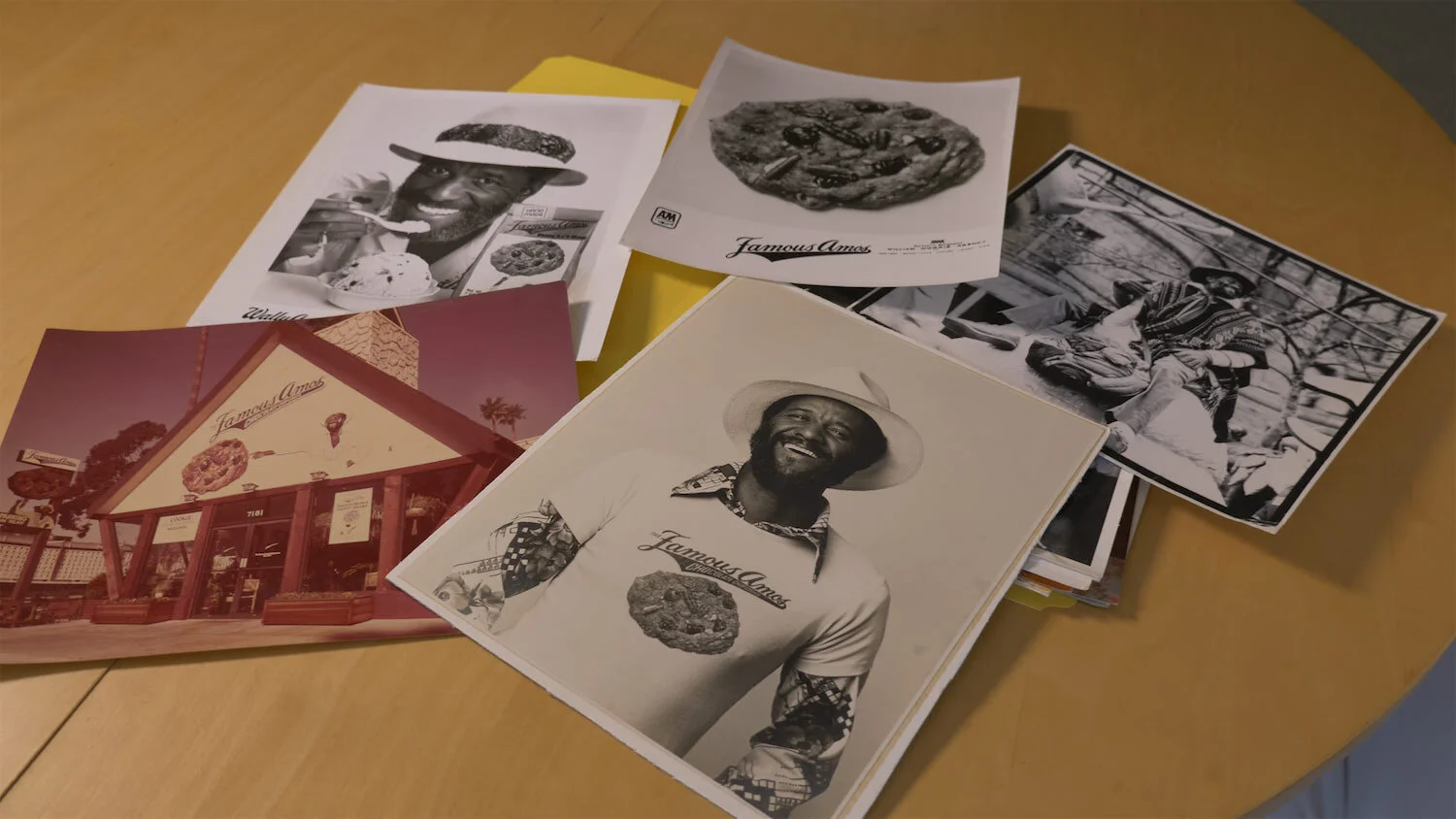
Another line item was licensing fees for photos and film clips. Thankfully, Wally had an incredible archival library of photos and had some really cool old film that had to be transferred.
One of the bigger cost centers was the legal clearance. I hired one of the best teams in town to clear this film, Donaldson and Kaliff. That ran me about $2,500.
Being a fellow indie filmmaker, you know nowhere in this budget are the hundreds of hours of the blood, the sweat, and the tears that went into the shooting, the producing, the directing, the writing, the editing, the marketing, the promoting, the selling of this film.
No. And those hours are never recouped at full market value. If recouped at all, but that's part of the contract trading pain for art.
Diving into distribution
Now it's time for everybody's favorite topic... Yes, going through the Big D.
Depression? Disappointment? No, distribution! (AKA depression and disappointment.)
My foray into distribution for this project was like a BLT sandwich. Just without the B or the T. Just lettuce on stale bread with expired mayo. Take a bite. Yummy!
After researching a bunch of distributors, I had a list of about 10. And my bar was pretty low, too. In order to end up on this extensive list, you had to fall between the range of: Shitty, but may not get fucked without lube or mediocre with slim, but possible chance of making $100.
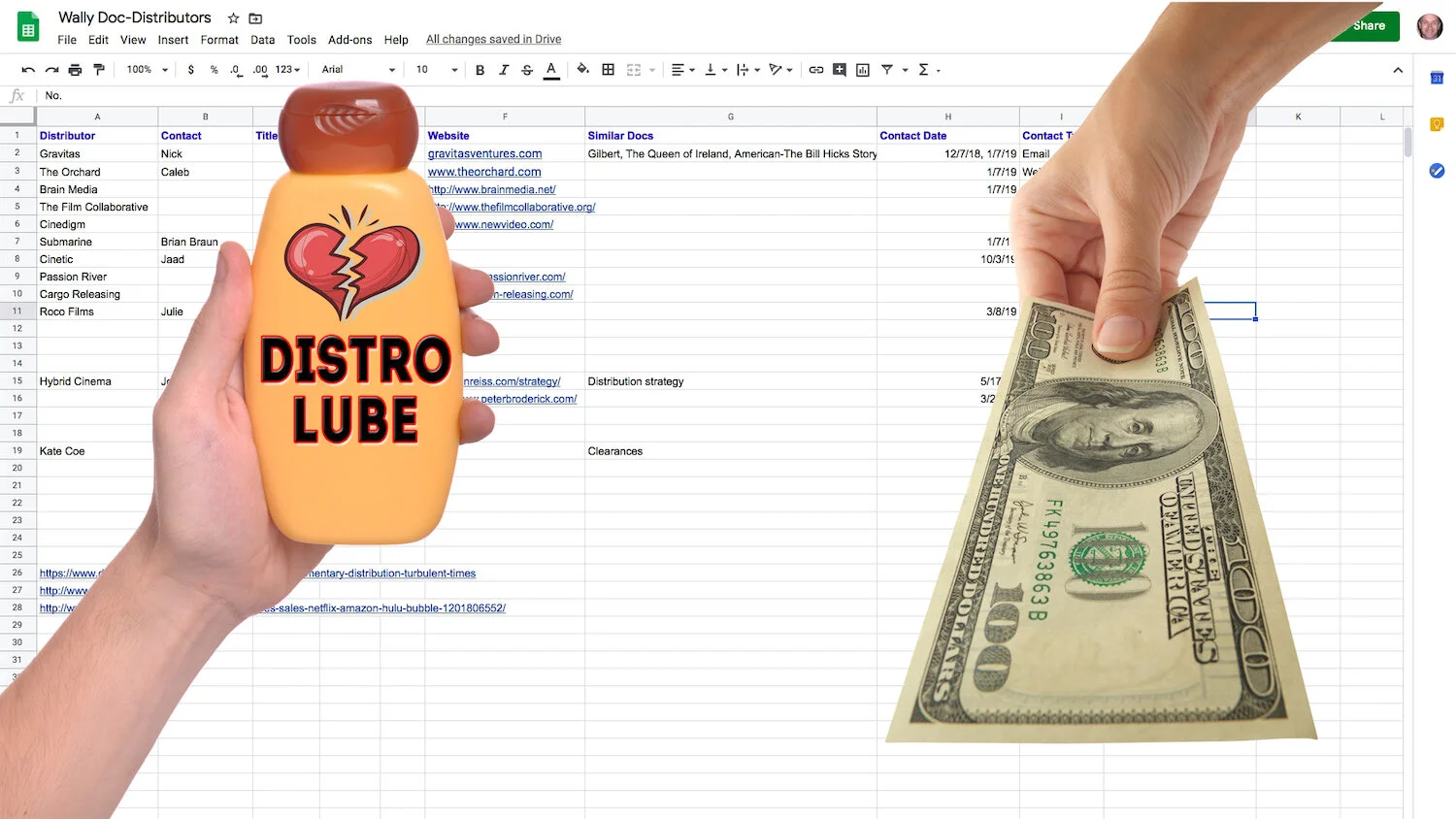
The Orchard, Brain Media, Submarine, Rocco Films, Gravitas...they all got emails. They all were sent trailers. Majority said, "No, thanks".
Gravitas said, "Hey, this looks interesting. Let's talk." I'm excited. Wow, a distributor actually likes my film. That enthusiasm quickly faded after we spoke on the phone.
From Gravitas comes a Crappy-tas offer. 15- year term, all rights, excluding theatrical, 25% distribution fee. I think I could do better.
Right about now, I was soaking-up a ton of content; sponging tips from Alex Ferrari from Indie Film Hustle and I even took The Film Audience Blueprint course from Rob Hardy at Filmmaker Freedom.
The depth and quality of that course really lit my fuse to think, "Hey, I could find and build a niche audience around this film and step out and at least match a Gravitas deal, if not do better."
The march to self-distribution began!
In addition to Gravitas, I did get a "yes" from Indie Rights and had a nice chat with Linda, one of its key players. It's one distributor people hold in medium to high regard and they definitely sounded very solid. Not very personable, but they definitely seem to have a solid game plan.
Just so you know, Indie Rights and every other distributor at our level will NOT do much marketing, if any.
That's something you have to be very comfortable with.
If you're not ready to market your film hard, don't press 'record'. Don't bother making a film, unless you have enough gas in your tank to take it across the marketing finish line. You're going to be huffing and puffing to get the word out and it's always going to be on You/Us, as filmmakers, to spread the word.
No one is riding-in on their Social Media Marketing Horse to save us. No one is coming in the rowboats. It's just us in that rowboat...with one oar...in a sea full of sharks and mutant piranhas with coronavirus.
It's up to us to paddle like shit to get to that island where maybe five potential audience members await and then keep rowing to the next Island where maybe 12 potential audience members, potential renters of our film... for $4.99 each...exist.
Let’s talk about marketing (and Facebook ads)
Which smoothly segues us into marketing, which actually is a good segment. And if we're talking marketing, we can only be talking about...Facebook Ads!
Not only that, of course, I employed some other strategies from reaching out to podcasts and bloggers, list building, funnel conversion, email blasts, all that, which we will get to. But first, let's start with the unicorn in the room: Facebook.
Come on, that's where the gold is, right? Well, at least in Zuckerberg's pocket. It used to be in mine, but now it's all in his.
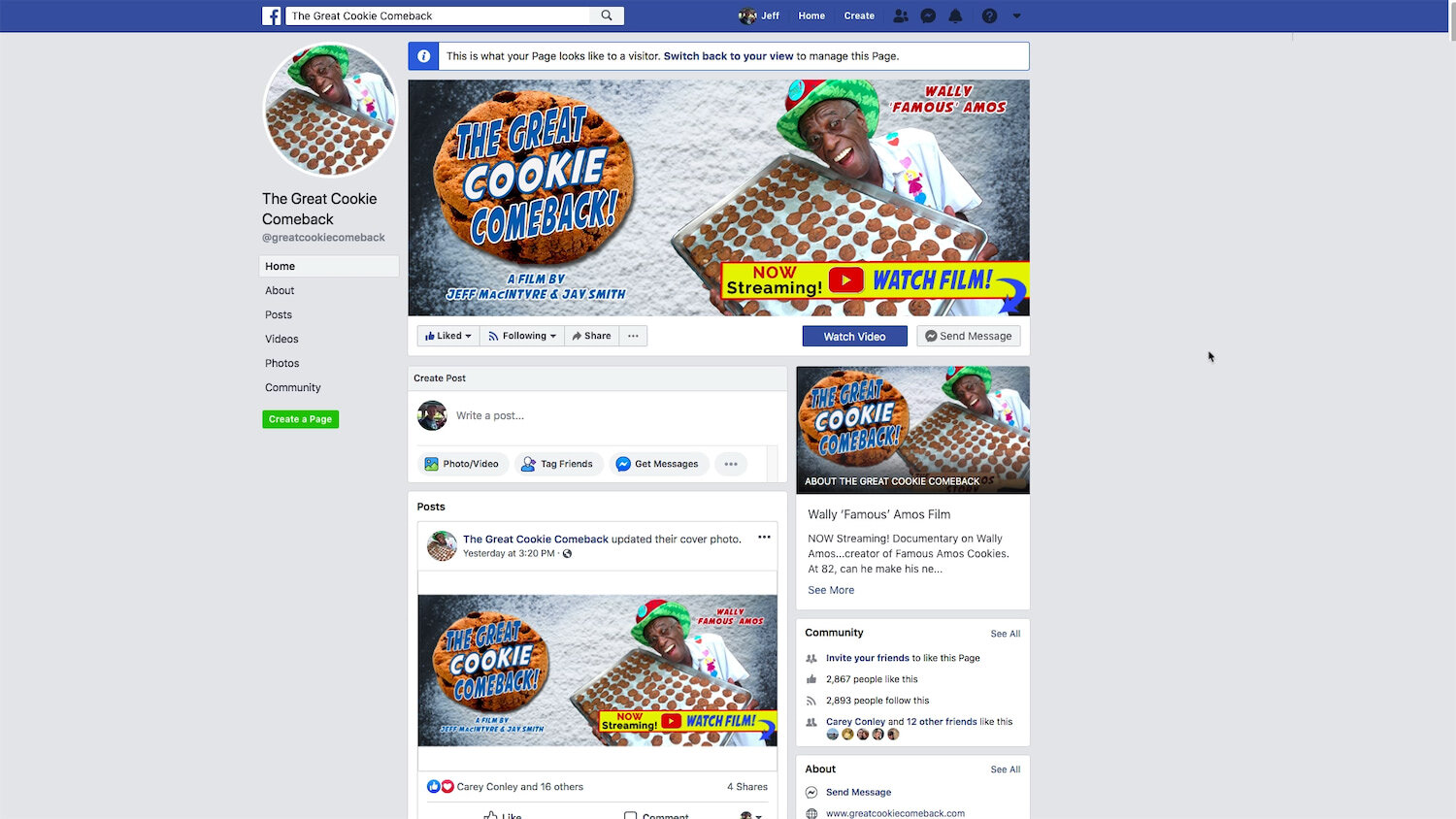
I launched the film's Facebook page in January, 2018. Looking back, I really didn't start advertising until 2019, because back then, you had a slightly better chance of your tribe seeing your posts organically. Now, good luck, it's 100% pay to play.
Over time, I was able to build up the page's followers to 2,893. Then I started ramping up again once I decided to release this damn doc. I wanted to get it out of my hair and push it through the creative birthing canal. It was time to get it into the world, so I could move on.
Honestly, it's not the best film I've ever made, but it's definitely good enough. It tells an interesting story. Hopefully, it helps Wally get some exposure and get him back on his feet making cookies and money.
But, it will not consume any more of my life. 82% is good enough for me, because a film that's 82% and out is much better than a film you're intending to toil on to get to 99% and then push out.
Reality check: You never will. Intentions don't pay the bills, don't springboard you to other opportunities. Drop the shit and move on. So, I did.
However, I didn't slack off. I hustled and created a ton of custom Facebook content. 110 posts, 28 original videos. Wally was a real positive guy, so I had a bunch of posts that incorporated some Wally wisdom, his positive sayings and slogans. This seemed to resonate with people.
Like I said, Wally had a rich archive. There were so many wonderful old photos that fueled a Wally Throwback every Thursday.
My sweet spot with this audience was 45 to 65 year olds. Many remember Wally back in the day and love the old photos. The archival material always did big 'social business'.
Topical content was also important.
Something I'd do around the Oscars was create an Oscar- themed post with a play on words from one of the best picture nominees. This year, Once Upon a Time in Hollywood was the nominee. So, Once Upon a Cookie was born. This is some cool artwork of Wally's original shop on Sunset Boulevard.
How much did Jeff spend on FB ads?
Let's get down to the nitty gritty. How much did Jeff drop of his hard-earned money, which he'll never see again?
Jumping into the clunkiest online interface, the Facebook Ad Manager. (Thank you for making this so difficult, Zuck. I really appreciate that.) As you can see, a whole lot of ads were running a whole lot of credit cards were swiping.
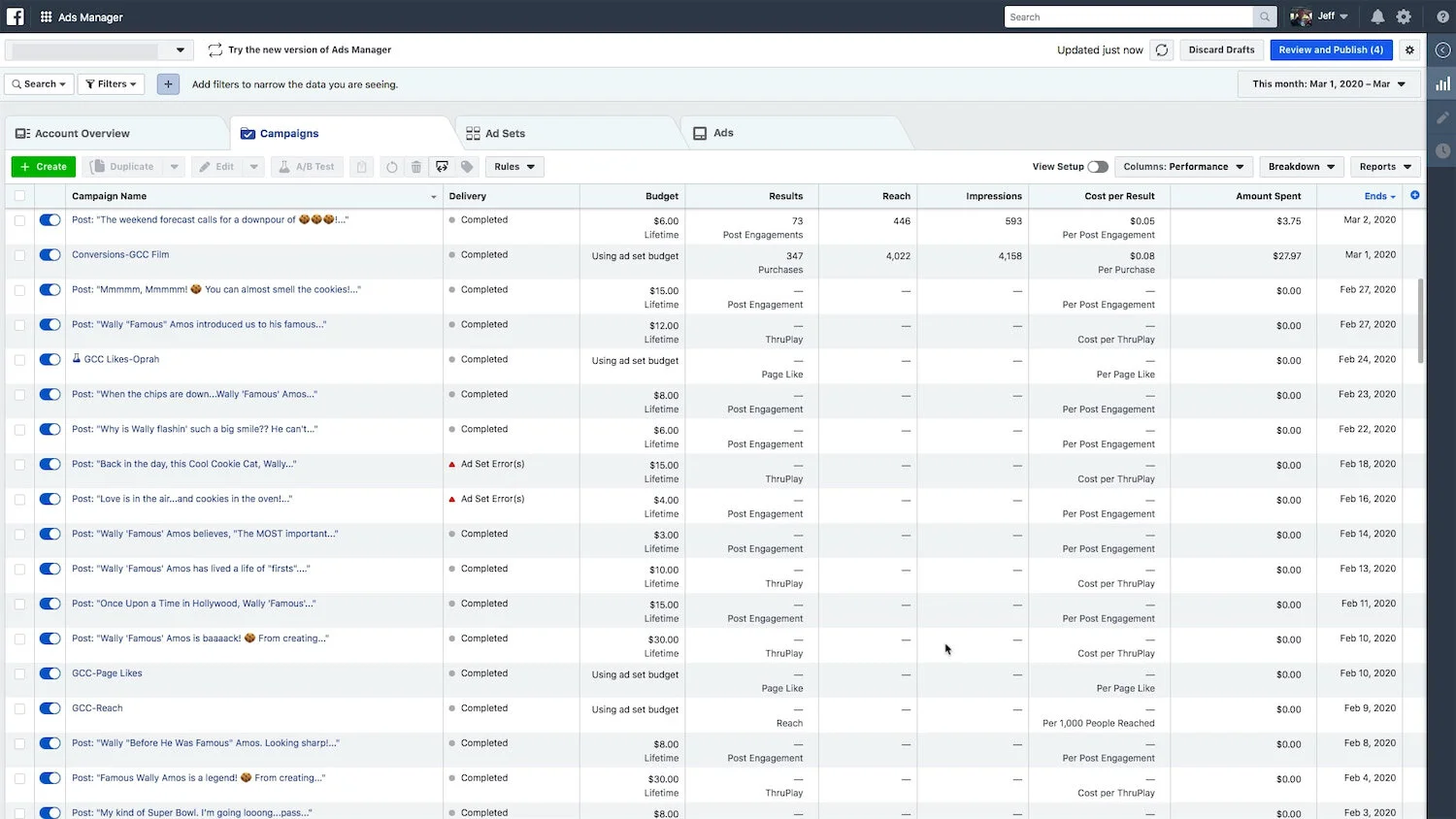
Since January, 2018, when I first started running ads for this film, I ran a grand total, as of March 2nd, 2020, 121 ads for $1,383.
In a little bit, all will be revealed. Was I able to recoup at least my marketing spend on the big launch? We'll find out.
But first, something interesting I found out.
Since this is an older audience, when I'd run an ad with just a current picture of Wally, it didn't convert as well as when I use a split screen then-now pic.
Using an old pic from the audience's heyday was a little blast of nostalgia to trigger a Dopamine hit and hopefully a like or a buy. It was key with his audience to always take them back to "sweeter" times.
You always need to be mindful of your audience's/niche's psychological trigger points and always be delivering content to push those buttons.
A Wake-Up Call!
At times, I'd get intoxicated by vanity metrics. The likes, the shares, the comments. At the end o' the day, who gives two flyin' fucks if you got 758 likes if you ended up getting zero sales.
It doesn't matter and is so easy to get swept up in the feel good rush of the likes and page followers. At first glance, that's awesome, but you always need to stay sober to what really matters.
And that is...building a passionate, engaged following and interacting with them online like a real human being who cares and not just a slick, used-documentary salesperson.
It's imperative to drive them from Facebook, Instagram, Twitter to your website where there's an opportunity to opt-in and sign up for your newsletter in exchange for a freebie.
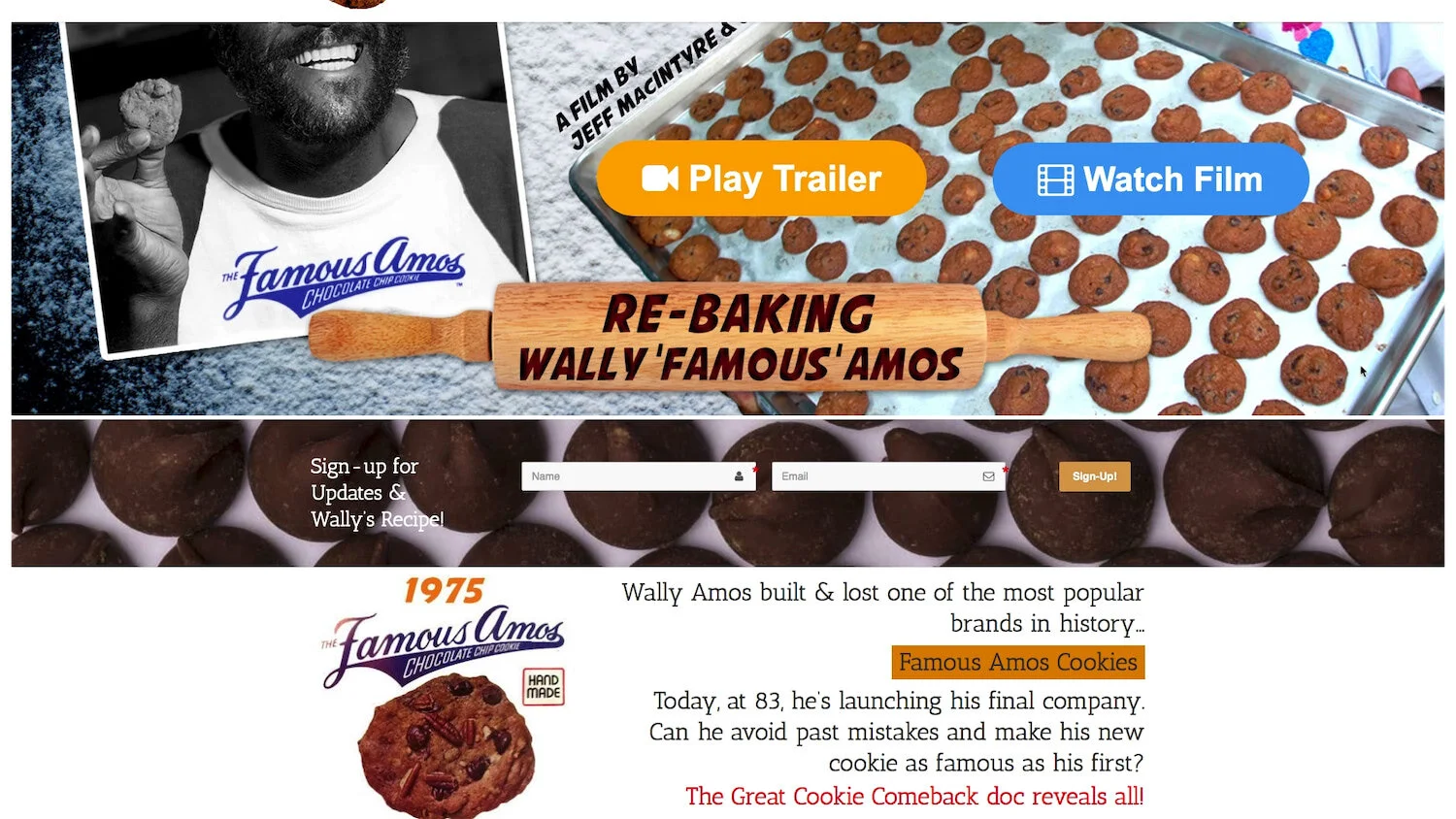
Building, maintaining and nurturing your own email list is crucial, not just for the survival of this film, but your next and next and next.
You know all this, but are you making a concerted effort into putting it into play?
Are you creating landing pages? Do you have mechanisms to grab email addresses that trigger an autoresponder email sequence? It's worth the effort and pays long term dividends.
Testing, testing, testing!
A couple months before releasing the film, I wanted to try a couple of different ad experiments. I eventually would test three things.
One, can I entice people to jump on my email list if I give them a free ticket to the film?
Two, can I get them onto the lis with a $5 off coupon?
Three, can I grab their email address by offering Wally's famous recipe?
All in, I spent about $173 testing different lead magnet ads. I collected about 189 subscribers. From the 189, if we drill down, you can see 52 takers for the free recipe, 23 takers for the $5 off coupon and a grand total of 11 who wanted the free ticket. That was surprising.
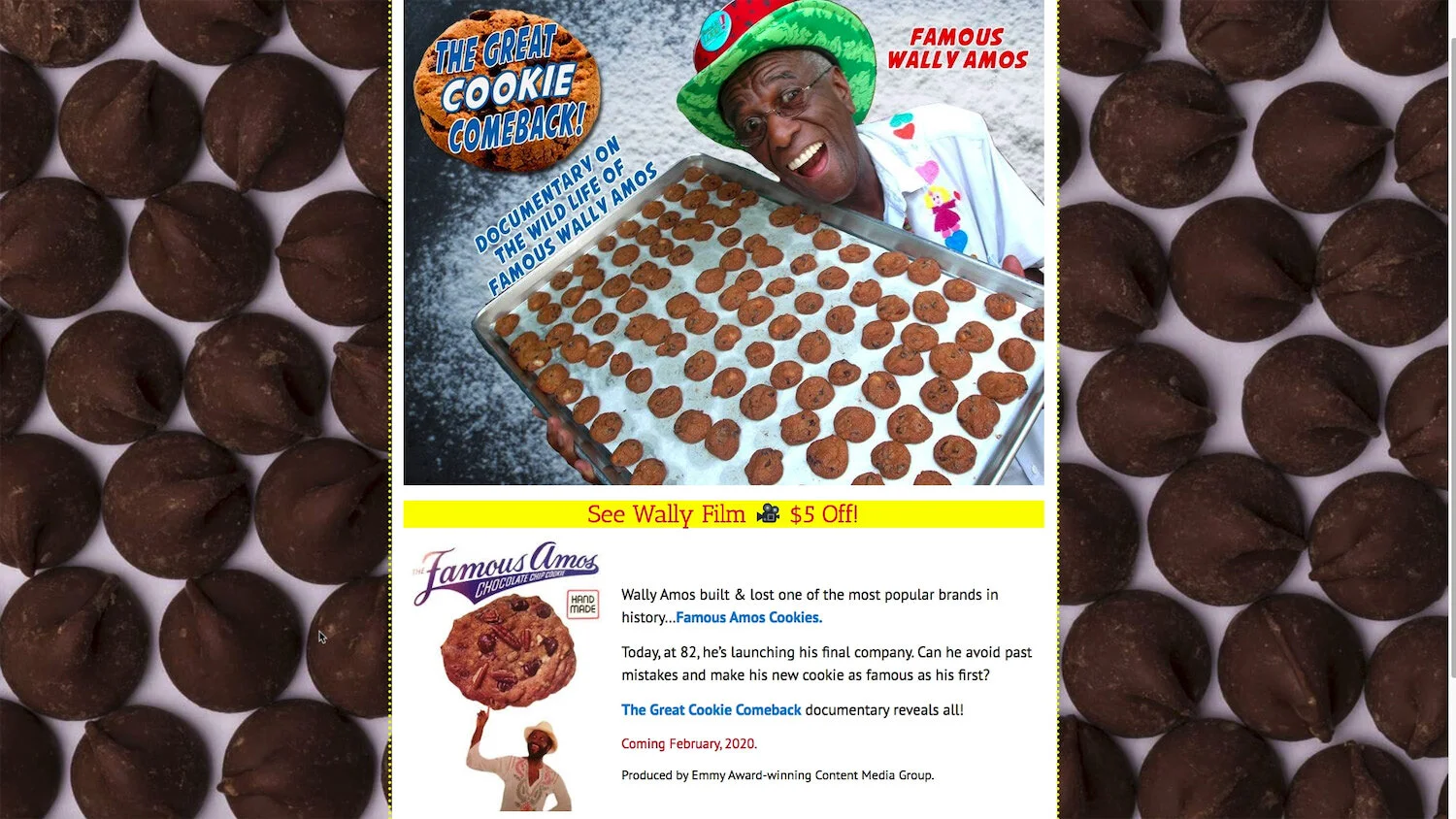
To do it again, I'd never do a free ticket because I had some takers. Why cater to the minority? You need to figure out what's going to move the needle with your very unique audience and then deliver an enticement that will excite them.
Where Jeff sold the film
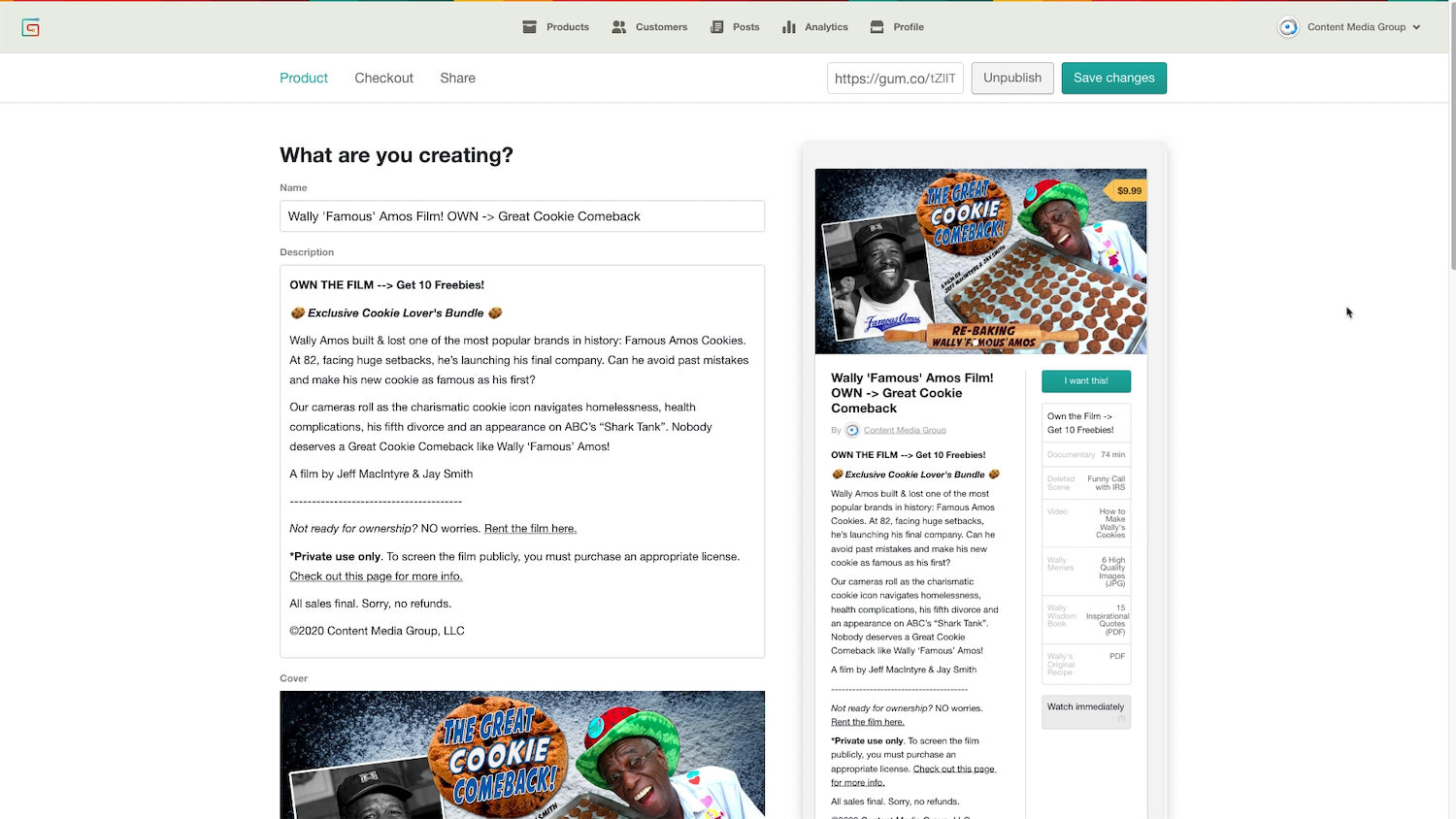
I decided to use Gumroad to sell the film. It's a pretty robust platform for creating different versions of your product. You could let people buy and download your film, or you could just restrict it to streaming only, which at this point, I have done.
As an enticement to motivate someone to buy the film instead of renting it for $4.99, for an extra $5, I pushed The Cookie Lovers Bundle. It included:
the documentary
a deleted scene
a video of Wally showing you how to make his famous cookies
some Wally memes, which I repurposed from the Facebook campaign
a book using the Wally Wisdom images re-packaged as a nice square book
Wally's original cookie recipe.
Always try to drive people to the 'bigger' ticket item. Only in film is a $9.99 product considered 'big ticket'. Why didn't I become a plumber?? So far, Gumroad has been working out. It integrates nicely into your website, too.
Early experiments in niche targeting
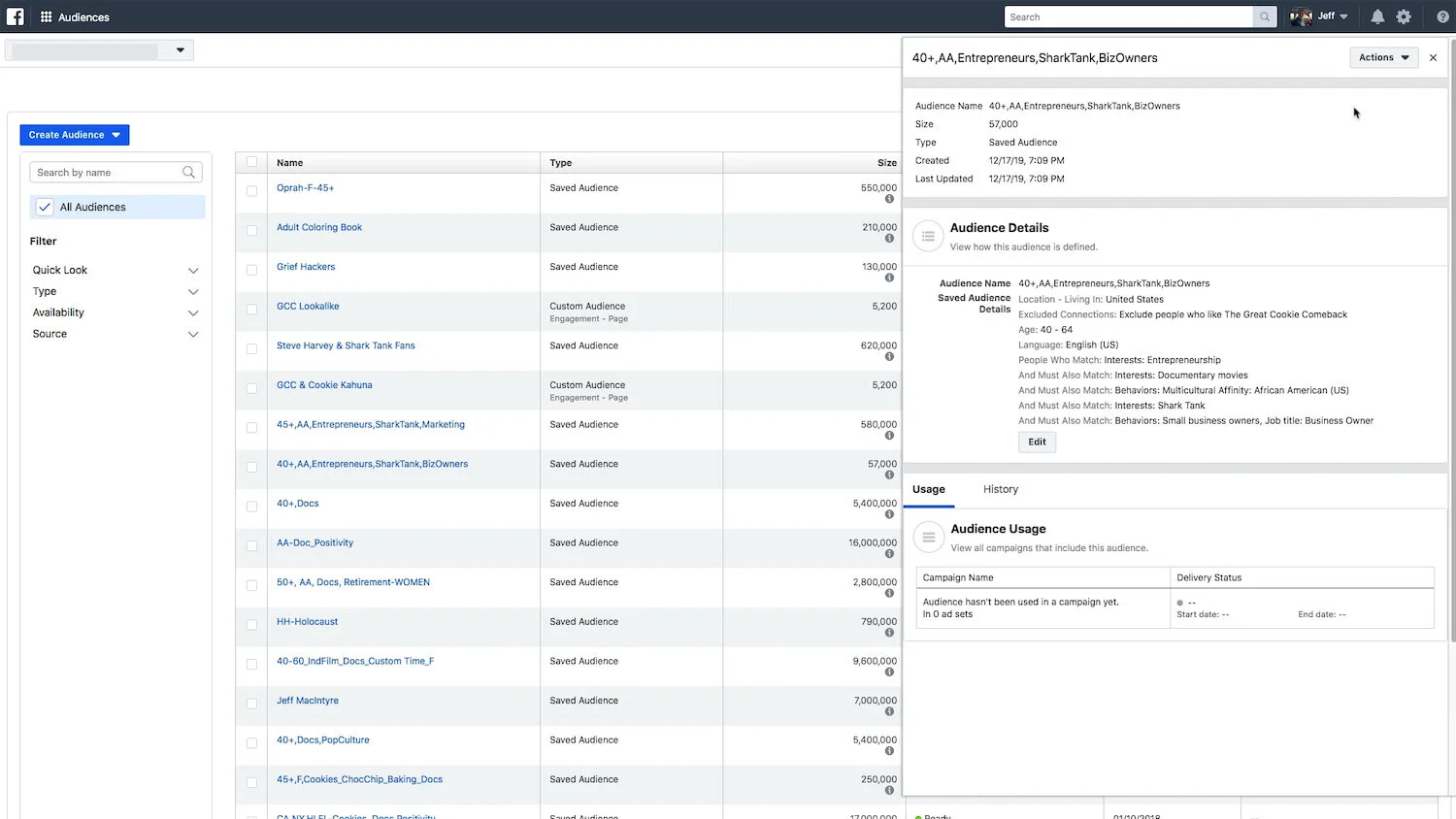
Super critical when running Facebook ads is making sure you laser target the specific audience you're going after. The real secret sauce to Facebook ads is the ability to micro-target specific groups, ages, regions, hobbies, or whether they've got a wart on their left or right cheek.
Some of the early audiences I were targeting were people who self-identified as entrepreneurs who like documentaries, Shark Tank and small business owners.
In the last couple months, I found an audience that really seemed to resonate...Steve Harvey fans who also like documentary movies and the Shark Tank TV show.
If you're not micro-targeting, you're truly macro-wasting your hard-earned money. Put Facebook to work in the way it was intended. Use their super sneaky, piracy marauding techniques to your benefit.
God knows they're pirating and selling all our personal information. Why not put that to use to benefit our films? But, you better understand how Facebook ads work, because there's a lot of options for ad types. What's your goal? Is it conversions? Vanity metrics?
Watch some YouTube videos and get some training, or you'll just be throwing money down a digital hole. And if you want to do that, I'll give you my email. It may make you feel better to know who it's going to.
Launch day (in which Jeff reveals his revenue numbers)
Come launch day, February 28th, 2020, I hit it hard with a multi-tiered advertising blitz, saturating people with Wally videos. If you have the opportunity to shoot custom content with your film's characters, do it! A short promo video with your main characters promoting the film is a fun way to push the film in authentic way.
The big question...Did you make any money off this silly project?
Funny you should ask. I mean, we could have saved a bunch of time if you would've lead with that question.
To recap, the ad spend was $1,383 for 121 ads. Forget about the nearly $15,000 in hard costs, hundreds of hours of time, talent and passion.
Does The Great Cookie Comeback lead to a great documentary payoff To Gumroad we go to find out!
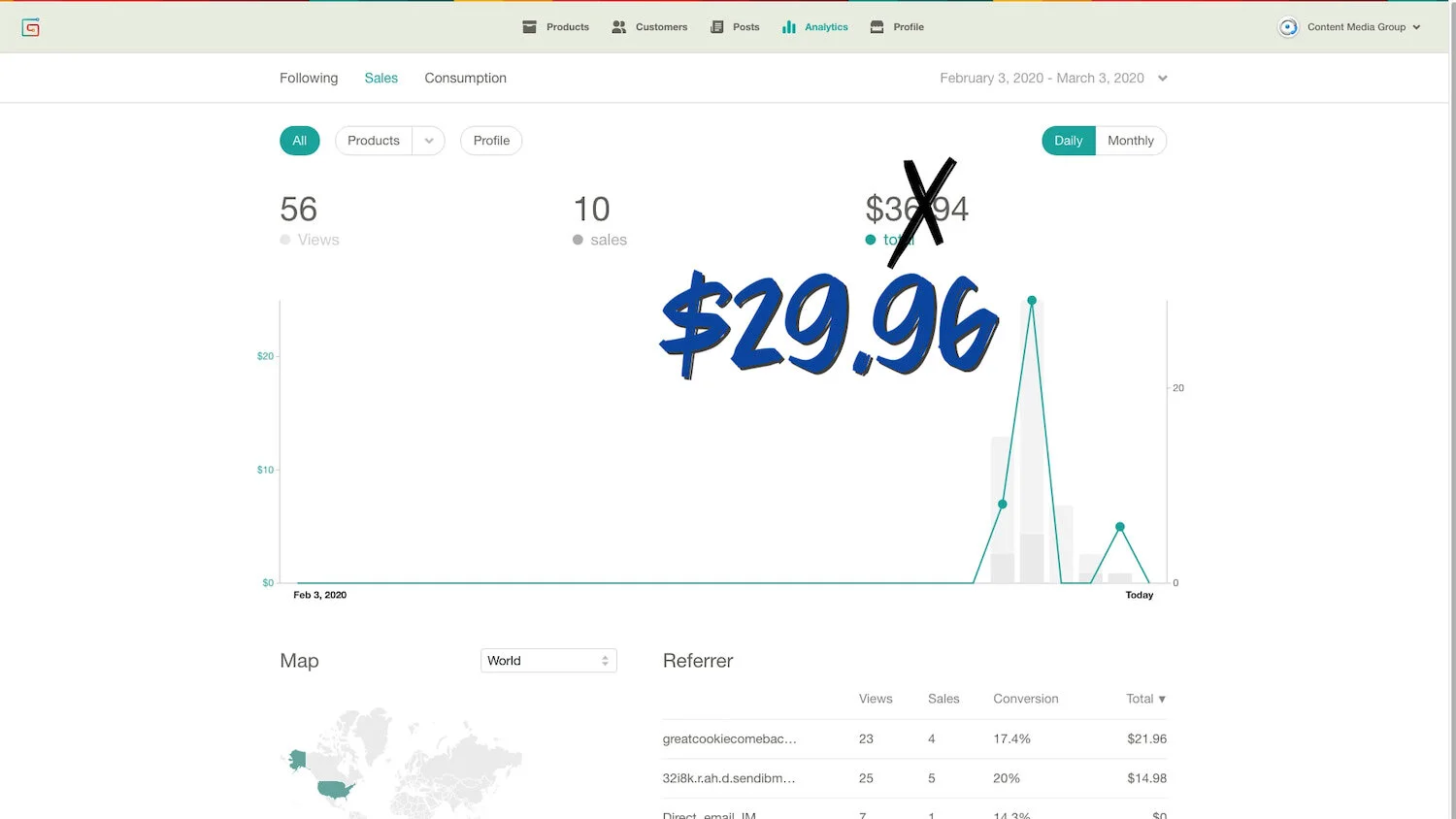
During its first week of launch, The Great Cookie Comeback produces a grand total of… 10 sales for a payout of exactly $36.94.
But, not really. Before I launched the account, I had to do some test transactions. We have to then subtract $7. Because I promised to share real numbers, it brings the total to a robust $29.96.
OR put another way, a profit of 11.9 boxes of Famous Amos Cookies. Yes, almost 12 boxes of the sweet, diabetes, cavity-inducing treat as compensation for almost five years of work.
Ah, it's a good time to be an indie filmmaker, ain't it?
Phase 2 revenue streams
Dry your eyes. All is not lost. Oh no, my sweet indie filmmakers. The 'big' money still awaits for Education and Institutional Sales and Senior-Related Organizations.
From senior and assisted living facilities to conferences where they buy content, there's potential within this sector; especially since they buy films to show at these facilities.
There are thousands of facilities across this country who'd love to meet the charismatic, uplifting, motivational Wally Amos. To me, that's a direct fit.
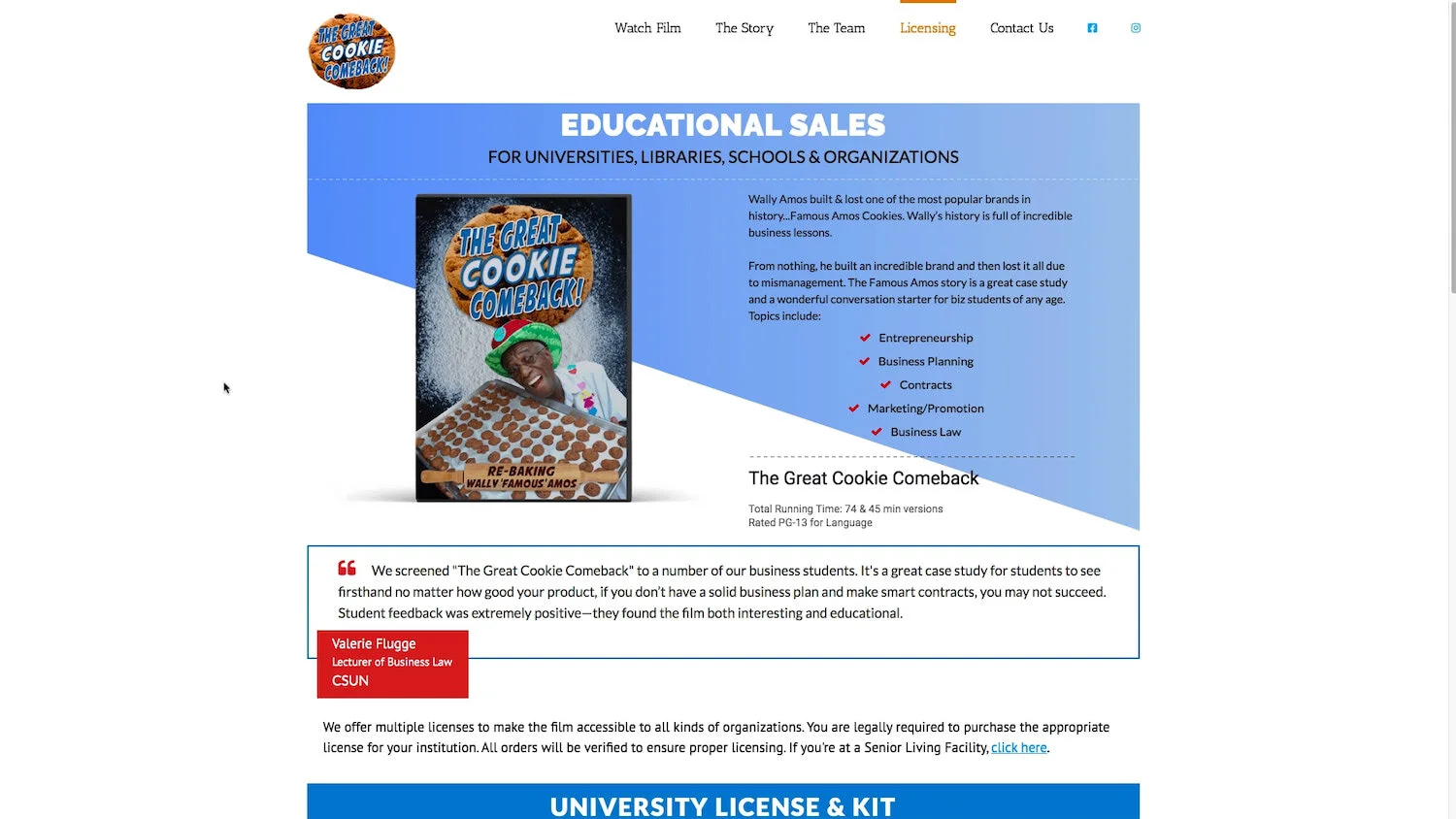
Also, the film's a great learning tool for business schools. Packed within Wally's story are great lessons from entrepreneurship to business planning, contracts, marketing, promotion, business law. I think that's a ripe audience to tap and for $200 bucks to license the film, there's a chance to recoup some of my Facebook marketing budget.
Here's the takeaway, thinking as a entrepreneur, not just a filmmaker, not just a creative is crucial for survival. You always need to have your business hat securely strapped to your head.
Creative licensing to senior living facilities
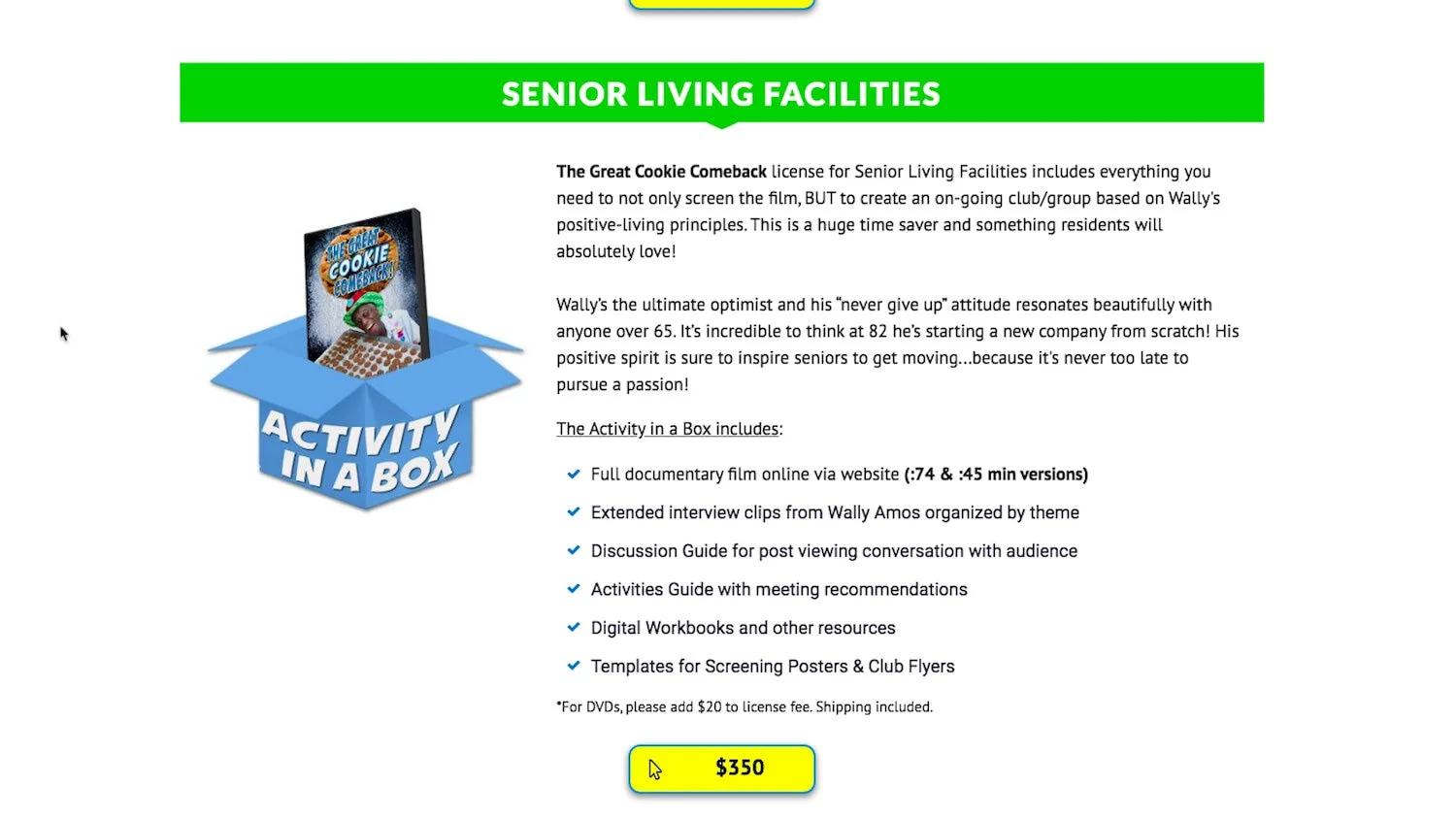
For senior living facilities, I'm creating an Activity in a Box, because there are activity directors at each of these facilities who are desperate to come up with daily activities for the seniors. Make their job a little easier and they'll gladly fork over a measly $350.
To test this theory, I did some research on facilities in my area and set up some screenings where I showed the film to a small group of sleepy seniors.
I think we only only lost two during the screening.
We didn't LOSE them. No, no, they just fell asleep. Some of them left early. Uh, most of them left early. For a filmmaker, it's a great feeling to hear loud thuds during your screening as bodies hit the floor.
Business school licensing
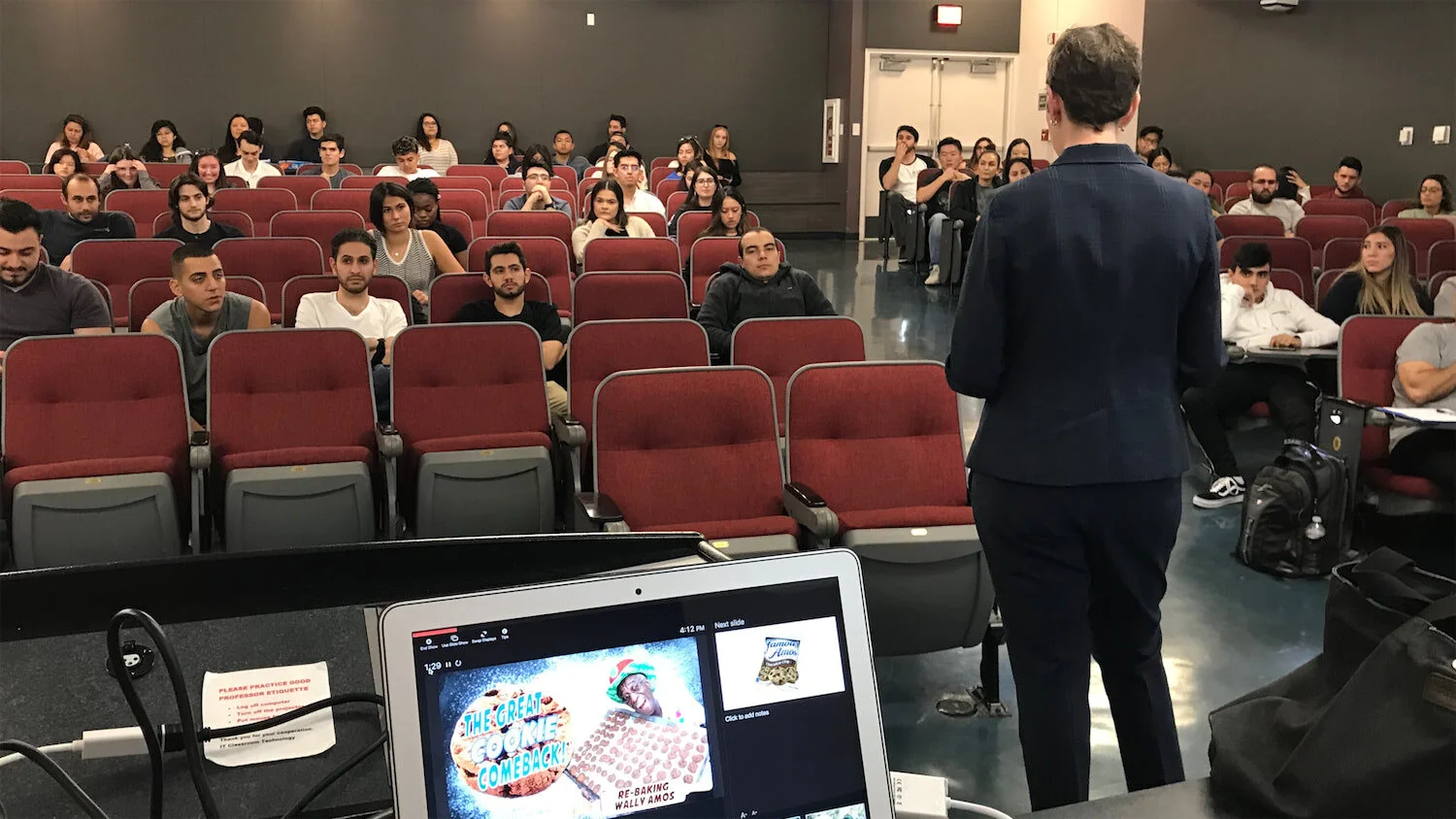
I also contacted business schools in my area and had a great screening at a California State University. In exchange for that, I was able to get some nice testimonials from professors, which I now use in my marketing.
That's the goal. Do a couple more screenings at biz schools and assisted living facilities. Rack-up more testimonials, get some feedback, make some tweaks, and hit the ground hard to sell this.
Business influencer collaborations
In addition to social media marketing, I reached out to influencers, podcasters and bloggers who produce content that mirrors some of the themes in the documentary.
I made them the following offer: "In order to do something different to promote this film, I'd like to work with you to create custom content that not only reflects the film's major message, but aligns with your mission statement."
For example, for a popular business podcaster, I said…
"Let's put together a course based on the principles in the film. You watch the doc, then address five areas which you think would be interesting to your audience. You can breakdown what Wally did right and wrong when he started Famous Amos and put it in a way which would move the needle with your audience. You'd score a pretty cool piece of content, which I'd produce for you. You can sell it or give it away for free to your audience. It's a great way to build your list, too."
All these podcasters/influences are hungry for fresh content. Why not help them solve a problem. Instead of begging for free promotion, give them something valuable in return. And, let's say it was a course, you could generate some nice rev-share profits.
If you sell the course for an additional $49-99, then you're pocketing extra money and you're thinking like an entrepreneur.
All this was in place and I had a couple of takers early on, but they all vanished. It's an idea that needs to be bookmarked.
If you made a documentary that has some good life lessons, figure out a way to transform it into a course. Online courses are huge now. Just find a podcast or blogger that's talking about this stuff and you're on your way!
Even though that didn't come through, I still think it's a great idea and something I'm going to push for.
Something that goes hand-in-hand with knowing your niche is figuring out if they truly want what you're selling. At the end of the road, that's the only thing that matters.
Are you producing a product for a hungry audience?
As entrepreneurial filmmakers, we need to make sure we have enough gas in our tank to then switch hats from producing to marketing to promotion to distribution and sales.
It's fatiguing and not for the weak of heart. You better have a hell of a lot of passion for your project, your topic, your niche in order to make it across the finish line. As creatives, the finish line is no longer, "Oh, I finished the movie, save as MP4 and upload."
No, no, no. That's really when the real race begins. After you've finished cutting, you better hope have enough money/energy to carry you through the next phase.
Fight on! We never know what's coming around the corner and this media landscape constantly changing. Opportunities will always await, but it means we may need to pivot and apply our skills in a new way. Some of us old timers resist change and prefer the old way, the old road.
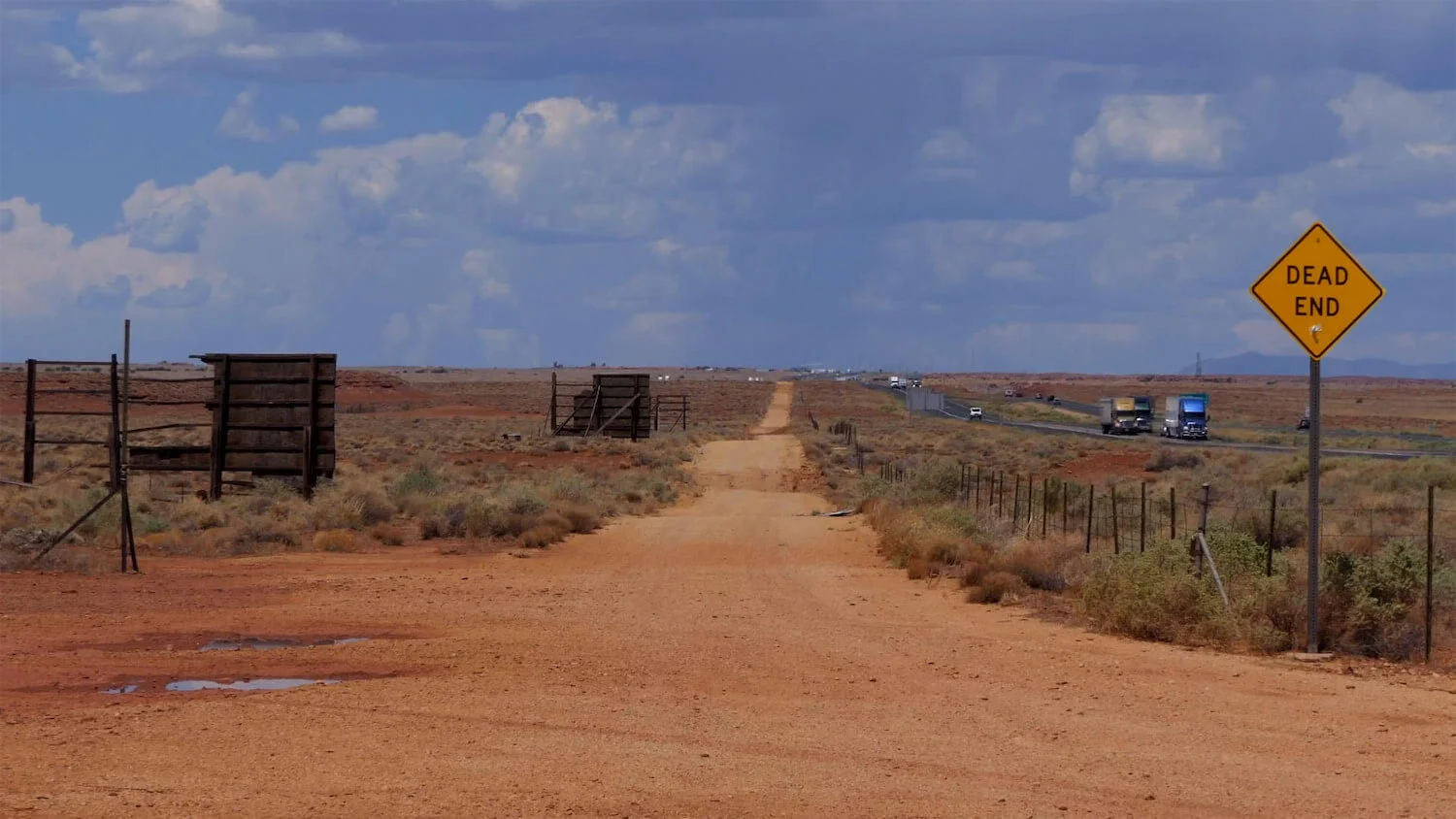
After all, it's been steady. There aren't many potholes. It's familiar. But this road, unfortunately, now is leading to a dead end for a lot of us.
Final Thoughts
It's crucial to pivot and find opportunities in these new spaces. They don't look anything like where we've come from. It's seeing things through new eyes and figuring out innovative ways to apply our rich skillsets.
The great thing about the old timers, we have decades of experience just waiting to be tapped. But, it's our responsibility to get innovative with our skillsets and find new ways to apply them to the ever shifting landscapes of audience demographics/needs and media platforms that don't resemble the mechanics of yesteryear.
If I can't make this feature doc work, that's on me. Come on, it's time to innovate. Why not chop this baby up into 8-10 different five minute episodes and then roll it out as a series?
Enough of this madness! Thank you so much for investing your time. Time, you'll never get back. (Sorry, no refunds.)
This is probably where I'd say, "Good luck to y'all!"
But, I'm not, because you don't need luck. As independent filmmakers, we don't need luck anymore. We need strength.
So, I wish you lots of strength to stay committed to your passion, committed to your why. Why did you hit record on that camera years ago?
I wish you strength to stay aligned with that passion, strength to endure storms that will rock your creative boat. I wish you courage to try new things, new marketing methods, new advertising channels, new self-distribution techniques. Perhaps some of you will get lucky on any number of those things, but luck is never a strategy.
Strength and forward momentum are essential for your growth and success. Taking a risk by putting your foot out and making the next step, that's the only way forward in this wacky, new world of self-distribution.
Stay strong!
But wait, there’s more! (free marketing mini course)
Right when you thought it was safe to continue interneting...Nope. I'm back!
So, "stay strong" felt good. It's rah, rah, go team. I still stand by that. But more important than staying strong is acting from a place of strength. And the only way you can do that is arming yourself with the right information… the right steps to guarantee a successful movie launch.
While I truly believe the techniques I used were proper. Many, on their own, had great merit. I stumbled in the execution of some of them and could really use some tweaking.
I'm excited to announce I'm partnering with the movie marketing expert, Rob Hardy, the Captain of the Filmmaker Freedom website.
He has this great course, The Film Audience Blueprint course, which I mentioned in my video. It inspired me to take on self-distribution. Rob knows his stuff, and that's why I'm so excited. He's agreed to dissect my marketing moves for launch 1.0 and give me a report card.
Where did it go right? Where did I go wrong? What could I have done differently? Then he will compile that information and give me homework and send me out to attempt launch 2.0 with a smart strategy.
The cool part? We're inviting you to ride shotgun. You'll have a front row seat to see what works and what doesn't.
Birthing a film is hard enough. Fellow filmmakers, I know you feel me. If you're wearing all the hats already, this next phase is grueling. I think if we can all band together and share tips and tricks that work, that'll only help us all along.
Here's how this is going to shake out. If you sign-up for our free mini course, we'll give you something unlike anything you've seen before.
We've all signed up for a mini course, right? We've all been disappointed by the content...thin, ultra-salesy content. All sizzle, no steak.
Nope, not here. The one thing Rob and I have in common, we like to overdeliver. I mean, look at the blog post you just survived! Who does that? We do, because we're all about delivering value.
This mini course promises to have actionable items. It'll probably be four videos where Rob does a deep dive on some of my marketing efforts and gives me actionable advice. Then you'll see me implementing some of it.
So, that's what our mini course has in store. Real world advice that you, as a filmmaker, can use right now.
That's why I'm so excited Rob has teamed up and is going to give me a chance to relaunch this movie. And relaunch in a way where I actually could profit. There's a thought, right? Profiting from indie film? Incredible! Who would suggest such a crazy thing?
Well, we're just crazy enough to believe it can work. And if you are too, if you believe in indie filmmaking, if you refuse to give up on your passion to make money from your art, this is for you and we'd love you to ride shotgun with us as we give this movie a marketing makeover.
If you're in, just sign up below. Thank you so much for your time. I know I have consumed 40+ minutes of your life you'll never get back, but we hope to pay that forward with this mini course. Thank you!